
Photographing Forests
A treatise on technology

I took a couple of days off in mid October and went camping in southeastern Minnesota at Frontenac State Park. The park overlooks Lake Pepin, which is part of the Mississippi River. Southeastern Minnesota is in the Driftless Area, comprising portions of Minnesota and Wisconsin that were never covered by ice in the last ice age. This created steep bluffs and valleys as the river cut into the terrain, and it’s quite hilly.
On my way there, I stopped at Nerstrand Big Woods State Park to hike. The park is a remnant of the Big Woods that covered parts of Minnesota and Wisconsin when European settlers arrived in North America. I went for two reasons. First, I was there on a botany class field trip in 1990, and I’ve often felt I never fully appreciated that class. Second, I signed up for the state park Hiking Club last year.
Each state park has a designated Hiking Club trail, and somewhere along the trail is a password. You earn patches and camping certificates for accumulating passwords (proof of miles hiked). Picking up two passwords on one trip helps, because Minnesota has so many state parks that I’ll never get to them all if I only hike when I’m camping there.
By the time I started hiking at Nerstrand, it was 10 am, and the sun was at a harsh angle. Forests are quite challenging for photography even in the best of conditions. There’s a lot of visual clutter with all the trees and the undergrowth. Forget photographing birds, as they’re generally too high in the trees to get a good angle, even if you have a powerful telephoto lens (which I don’t). Then there’s the problem of light. Not much of that in a dense forest, but in this one, with many leaves fallen and most of the others turned, lots of harsh sunlight streamed in. However, the light was in high contrast with all the branches and trunks.
A certain amount of contrast is pleasing. Very sharp contrast, however, with very light lights and very dark darks, just adds to the visual clutter of all those trunks, branches, and undergrowth. It’s a good time to pull out a macro lens and do some closeup photography, but I hadn’t brought a macro. Mostly, I’d brought my camera to photograph the waterfall, but was disappointed when the angle and direction of the sun made for really horrible pictures.
I might as well have left my camera in the car and saved the weight while hiking. Since I had it with me, I decided to see if shooting in black and white, or using some of the advanced color features of my OM System OM3 body could help. Short answer: no, it didn’t. Here’s one of the “better pictures.” See what I mean about too much going on? That tree on the right would be lovely, if only you could notice in all that visual clutter.
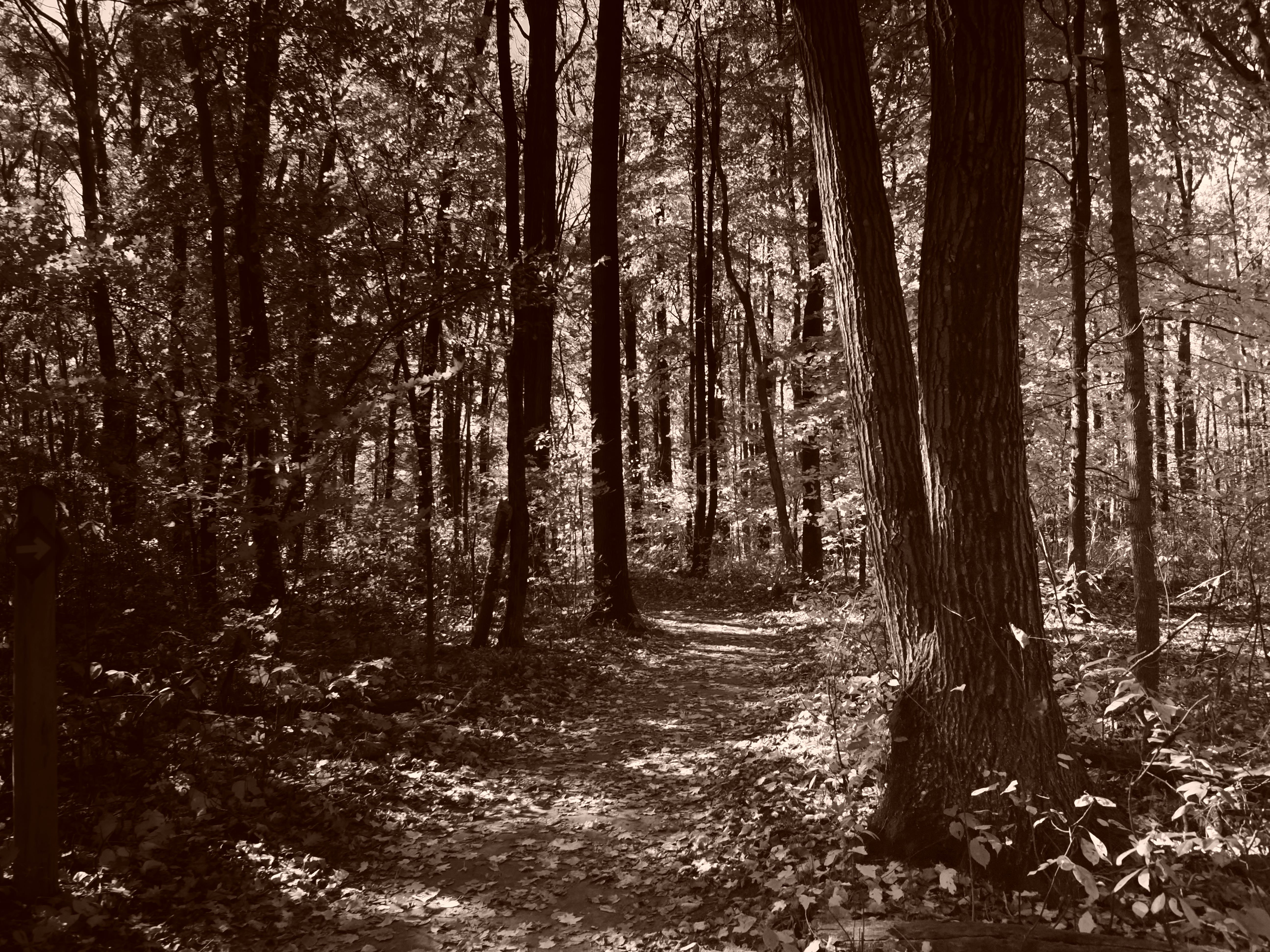
When I was there in person, this scene felt airy, open, and magical. The tree on the right stood out, and the ones behind it weren’t so noticeable. I wanted to capture that with my camera, but simply couldn’t. Our eyes and brains work together to create depth, but cameras can’t do that. They record everything as a two dimensional image, and it’s the skill and experience of the photographer that makes you believe otherwise.
One way photographers deal with shooting in the forest is to get there when the light is favorable, and then process the image in software such as Photoshop. This is called “post processing”. Post processing allows you to have more fine-grained control over the light, color, contrast, and other qualities of an image. In the picture above, for example, I could soften the contrast and appearance of the background trees so they’d blend together and not distract so much. I’d leave a sharper contrast with the tree in the foreground on the right, however, to help you notice it.
When digital cameras first made their way to the masses, the use of Photoshop resulted in endless arguments on the internet. The purists argued that post processing after the picture was taken might be art, but it wasn’t photography. Altering the image beyond some small tweaks to things like contrast was lying, unless you disclosed it.
I felt that way to a degree, but I also saw the irony. When cameras first came out, artists rejected them as an artistic medium. Photography was held separate, and I think this argument had something to do with artists feeling threatened that their work would be pushed aside. Who would value a painting if they could just go photograph the subject?
There was an underlying presumption that, unlike art, photography doesn’t require artistic talent and skill. The camera did all the work. To this day, there are photographers who rankle if someone says they love an image and ask what camera the photographer used. Such photographers believe the question implies they have no skill—that the camera did all the work.
I think that’s generally a misreading of the question. Yes, skill is required to take good images. However, there are things I can do with modern equipment that I couldn’t do with the Kodak Instamatic that got me hooked on photography in the 70s. My iPhone can’t do as much as my mirrorless camera system with interchangeable lenses, or I’d have never spent the money on them. So I hear the question as legitimate curiosity and not a backhanded compliment.
Cameras did change the world, but artists are still here, and saying photography is an art isn’t controversial now. The same is true of post processing. What used to cause endless internet spats is now so commonly used that if you don’t use software like Photoshop, your images simply won’t look like those of many popular photographers.
I spent a long time wondering why I wasn’t a good photographer and couldn’t get the results the pros were getting, until I realized they were getting those results by starting with a good image, then post processing. I’m really torn about that. On the one hand, I’d like my images to look like what I see in my mind and what I saw in the field. On the other, I spend enough time on a computer.
You can get awesome images without using software, of course, but you can get many more if you’re willing to post process. When I first bought my new cameras, I thought I’d stick to what I could get without a computer. That meant I would shoot jpg files, which are much smaller than the files used in post processing. That would save considerable storage space, in addition to minimizing my computer time. I would stick to cropping and some small tweaks.
If you want to post process, you have to shoot in RAW. RAW files contain considerably more digital information about an image, which is what allows you to do sophisticated edits in post processing. The files are also bigger—20mb RAW vs 10mb jpg for my cameras. However, there’s a learning curve to editing RAW files, and I have enough on my plate.
In spite of my wish to keep things simple, my desire for images to look a certain way has won out. I mostly shoot RAW now, but I still have to learn to edit. That’s a project for this winter, which is why my newsletters are currently light on photography. I have too many hobbies!
Anyway, I do get plenty of images that are fine straight out of the camera, but I still need to convert the RAW files to jpgs to upload them here. My OM3 camera, however, has lots of automated ways to process images in camera while the image is being taken. The result is automatically saved to jpg, even if you shoot RAW. It’s supposed to be the best of both worlds, which is why I started tinkering with it when I ended up in a forest with crappy light.
That in itself is its own learning curve, of course. One I need to play with much more to figure out when and how to use it to create something worth sharing. Did I mention the part about having too many hobbies? Still, if your images are going to suck anyway, why not see what you can do with the cool features built into your camera?
I didn’t end up with anything good from Nerstrand, although who knows, maybe I can salvage something from the RAW files that were saved along with the jpgs. However, I did end up with some decent jpg images at Frontenac. I worked through a bit of the learning curve on the camera’s ability to manipulate color, and I had better lighting helping me out. One of the reasons I love camping is that it puts me on site for a couple of days, making it easy to take advantage of the times of day with the light I want.
So after all that technical talk, I hope you’re ready for some pictures! Or did I bore you, and you haven’t read this far? For those who stuck with me, I hope you learned something interesting you didn’t know before.
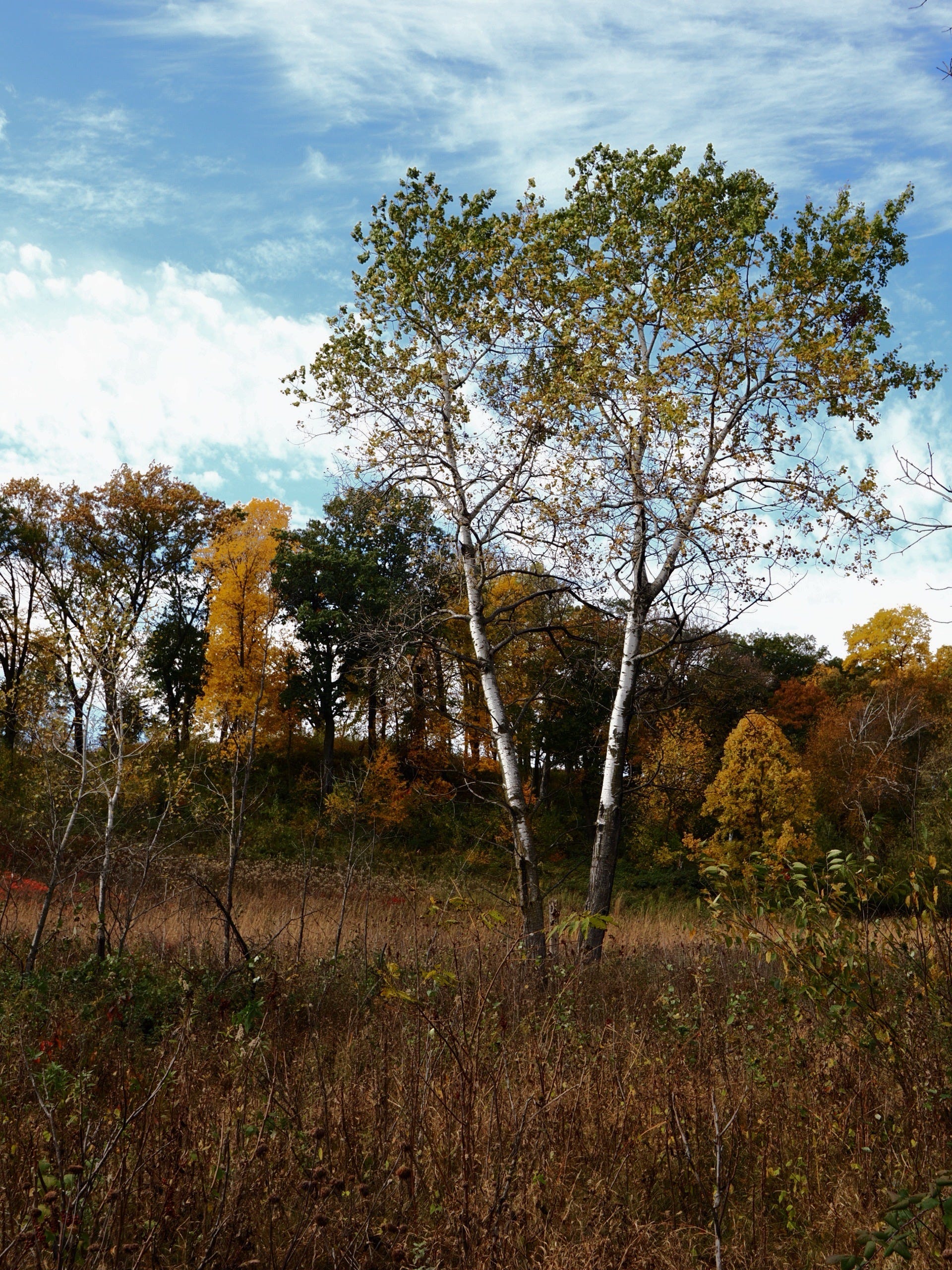
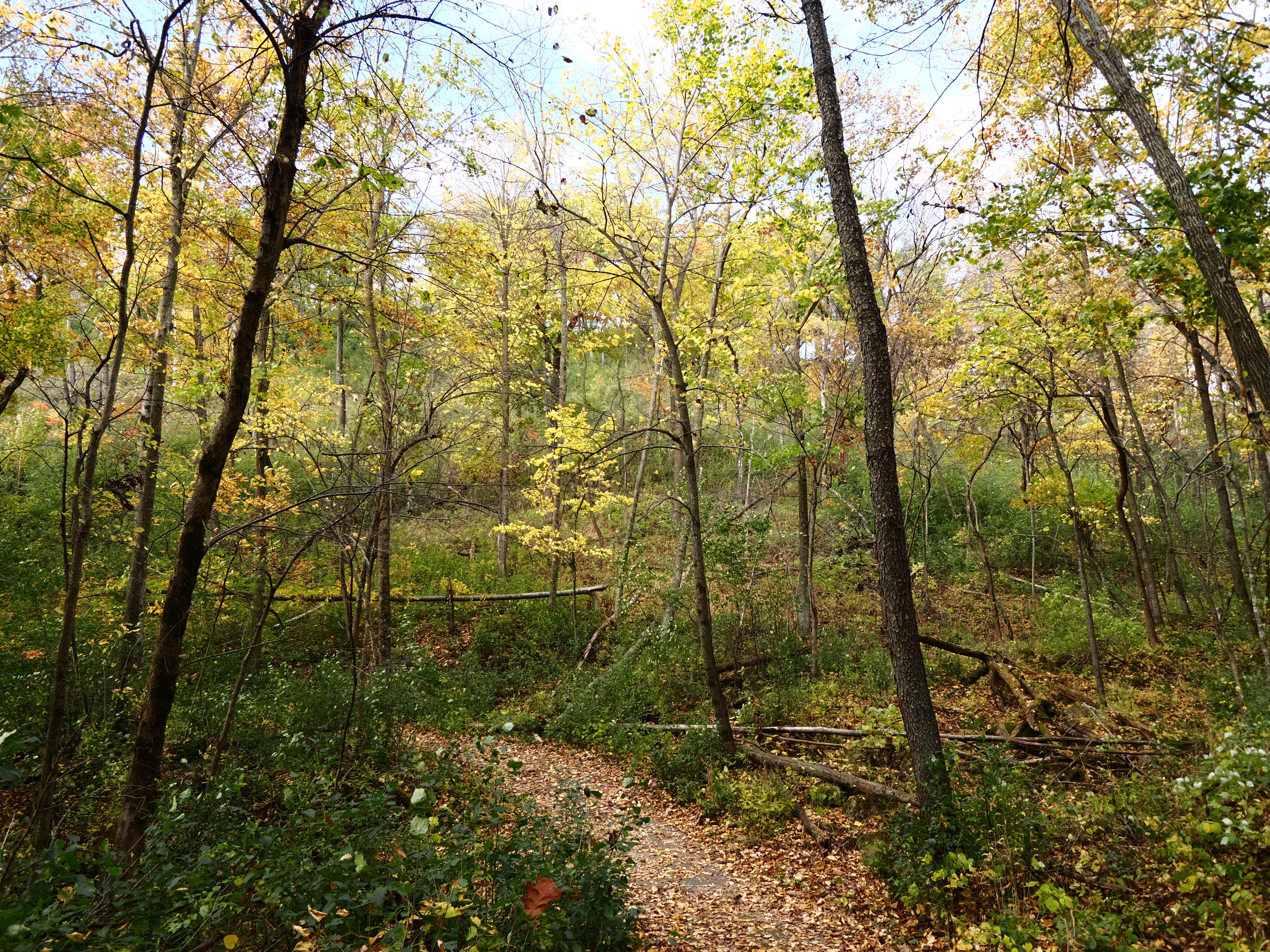
The two images below took advantage of the OM3’s ability to alter the colors in an image while it is being shot, and I’m quite happy with them. Notice in the second picture how the trees in the back are less distinct, so you get a feeling of depth? I wanted that in the first picture in this post.
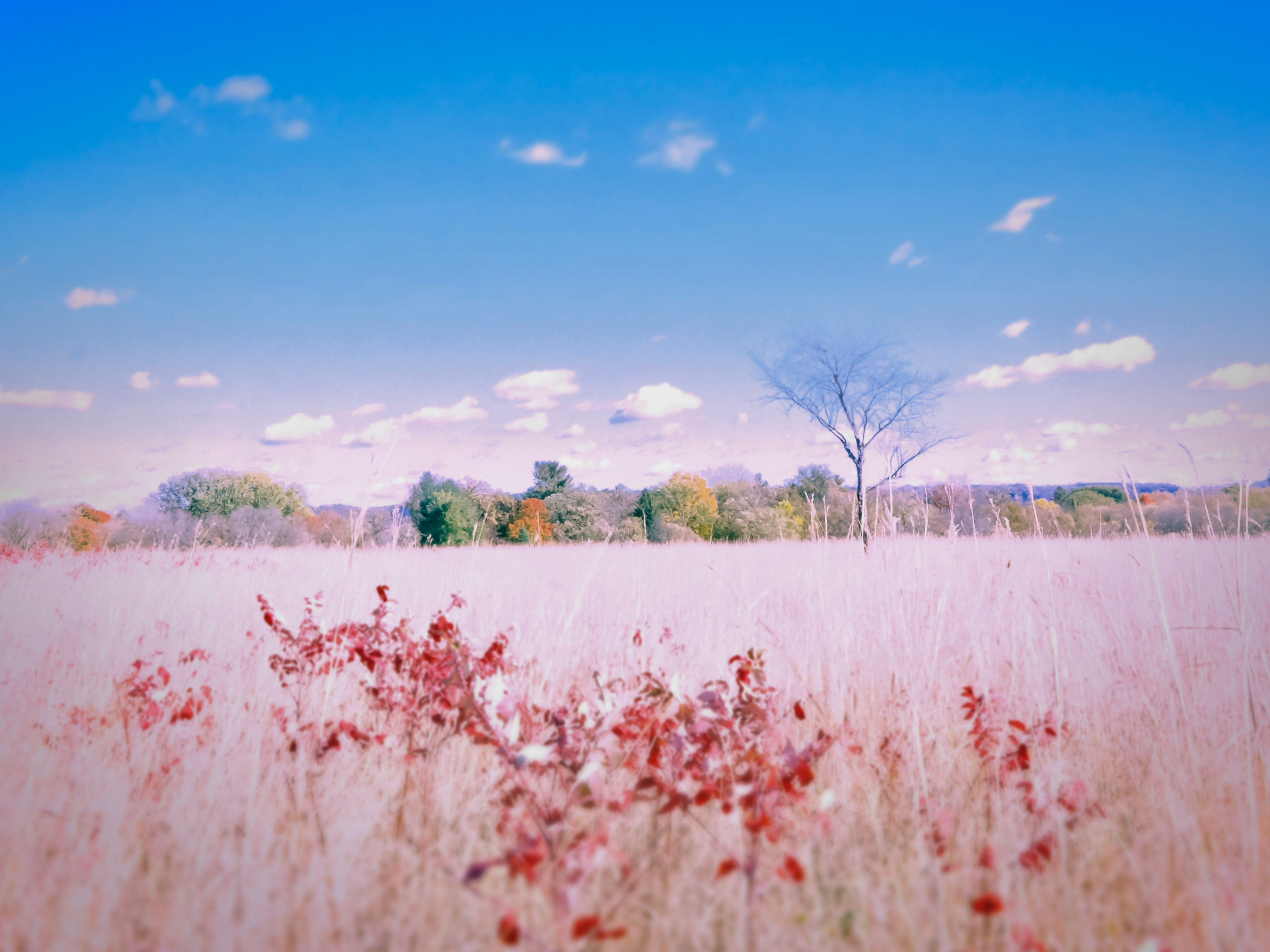
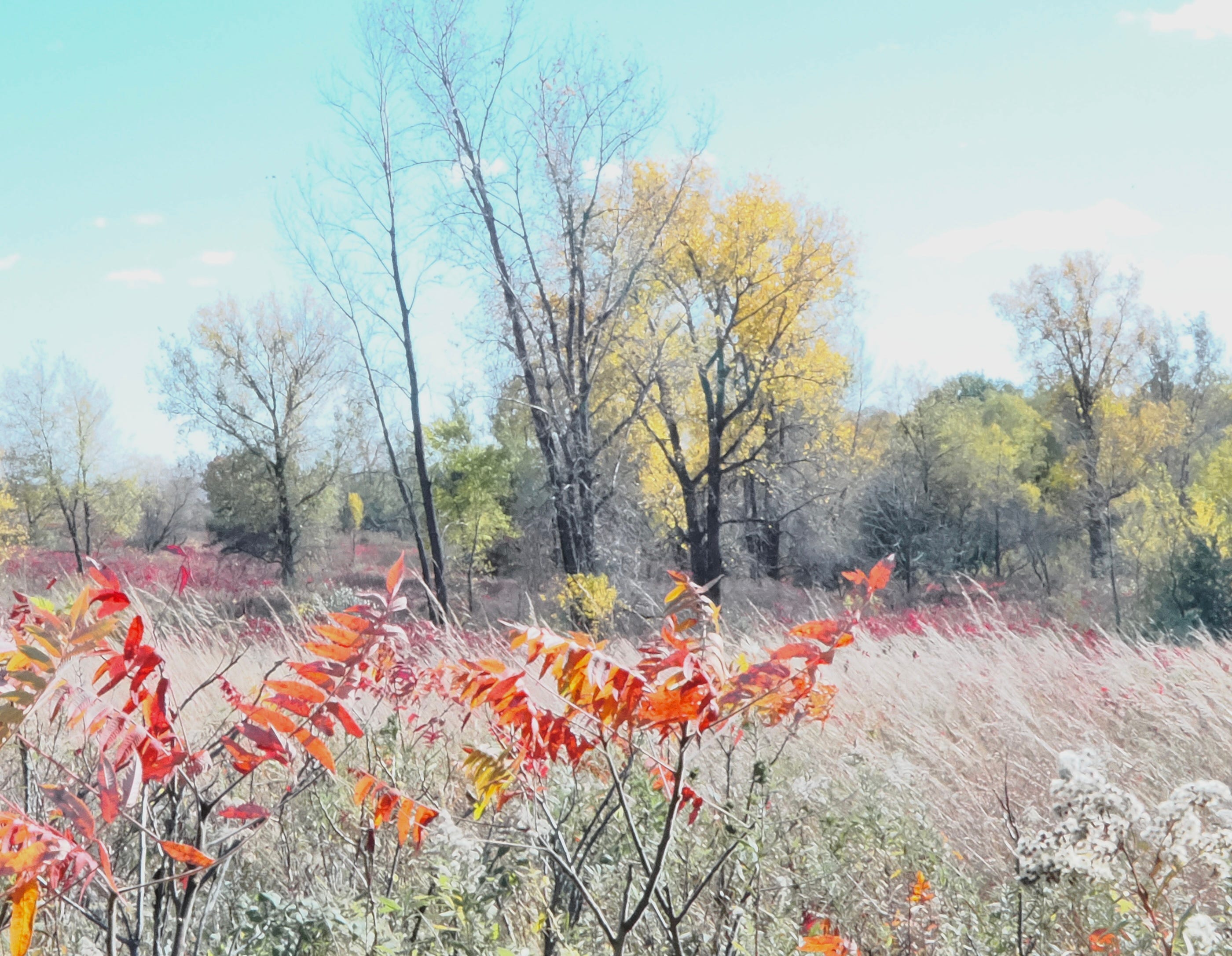
The two images below were a mistake. I set my camera up for astrophotography, and forgot I’d done that. The results are surreal, and I rather like them. If you didn’t think photography was an art, this might convince you. They’re what Bob Ross would have called “happy accidents.” There are even happy little trees in them!
Thanks for reading Cricket Corner Art! I’d love to have more subscribers, so feel free to forward and share if you know someone who might enjoy these newsletters.